The Competency Gap
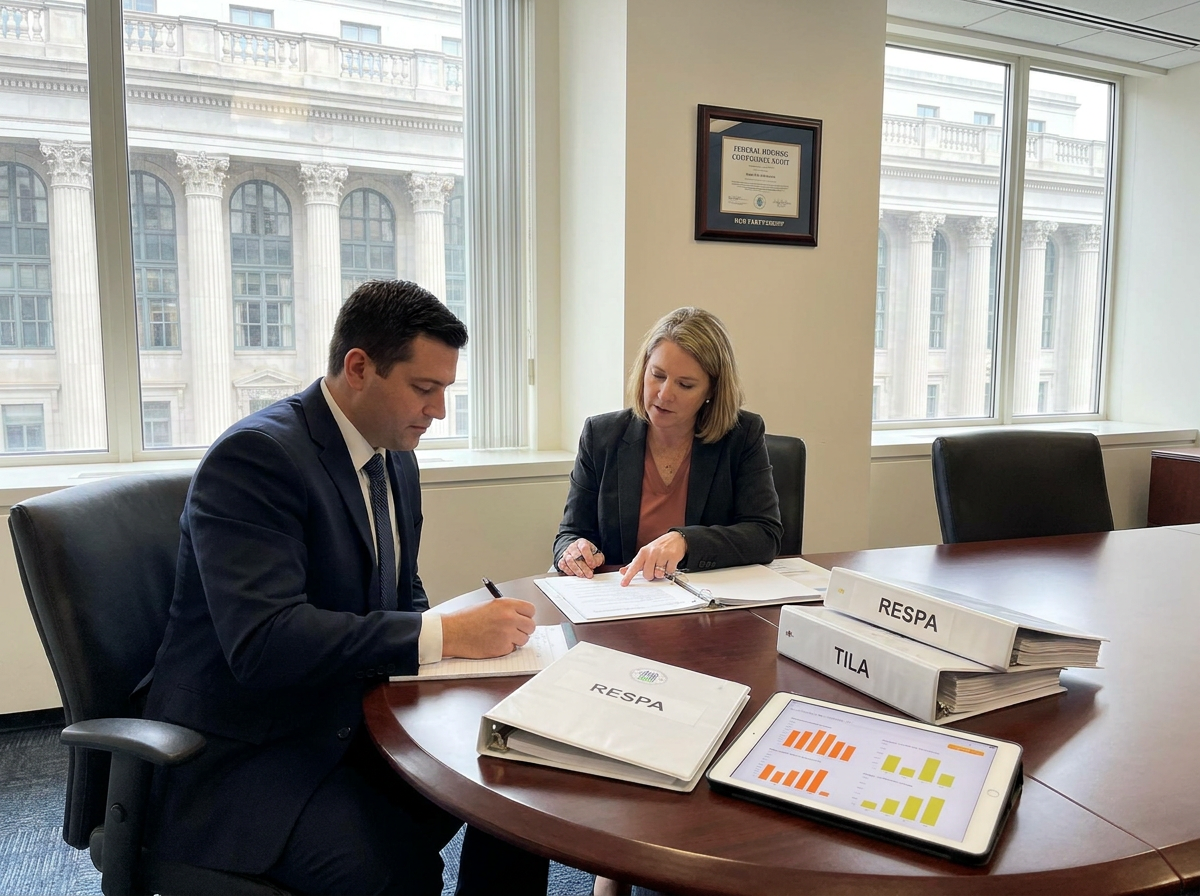
Five licensed, registered or commissioned roles carry out a foreclosure, and no single body oversees what they produce together. This short video shows what the training for each role does not reach.
Get the full slide deck
When a homeowner’s file moves past what housing counseling can resolve, such as servicing errors, misapplied escrow, dual tracking, or possible violations of RESPA, TILA, FDCPA, FCRA, or Regulation E, we examine the account in detail, identify where the servicer went wrong, and work to correct it for the homeowner. There is no cost to your agency, and a counselor always has somewhere to send a homeowner who would otherwise be turned away.
Serv Inc. is a private organization. It is not a law firm or a HUD-approved counseling agency, and it charges your agency nothing. Offered as a community resource under 24 CFR 214.103(j) and HUD Handbook 7610.1.
Serv Inc. is a private, membership-based consumer-protection organization. Homeowners enroll with us directly, and we work only for them. We are not a lender, a servicer, a debt collector, or a law firm, and we accept no payment from any of them.
Our work is deliberately narrow. We handle the mortgage servicing and contract disputes that fall outside a housing counselor’s scope, the situations where a homeowner needs someone to examine the account in detail and hold the servicer to the applicable rules. Your counselors continue the work they are approved to do, and when a file requires close, account-level investigation, they have a place to refer it.
At any given time, most of the homeowners we work with are still in active investigation. These matters are seldom resolved by a single letter, and we account for that from the day a file opens.
Legal aid offices, state attorney general consumer divisions, and mediation programs handle foreclosure defense and general complaints, and they do that work well. Few of them run the RESPA protocol that a servicing dispute requires, which includes Qualified Written Requests and Notices of Error filed against statutory timelines, forensic review of servicing records, payment histories, and escrow, and violations documented alongside the record that establishes them.
That capability is scarce across the foreclosure-prevention market. An agency’s referral base can be complete on paper and still leave this gap open. Filling it is the specific role we serve, so that a homeowner with a servicing dispute has somewhere to go.
Every referral begins with a close examination of the homeowner’s own records, including the note and mortgage or deed of trust, the payment history, escrow analyses, servicing notes, and correspondence. We measure what we find against the governing statutes and rules, which include RESPA and Regulation X, TILA, the FDCPA, the FCRA, and Regulation E, and we document each error or violation alongside the record that establishes it.
A finding goes into the file only when the account records and the governing statute both support it, and we set aside anything that falls short of that standard. That discipline is what allows a servicer, an attorney, or a regulator to rely on the result, and it puts the homeowner in a stronger position once the account has been examined.
A mortgage servicing dispute often comes down to a single misposted payment sitting inside several years of statements. We review the complete file for that reason, going through it line by line. We remain with the matter through the foreclosure timeline and calendar every statutory and procedural deadline, so that no right lapses for want of a date.
We do not originate, service, or modify loans; do not negotiate settlements; and do not provide legal representation.
What the records contain determines what becomes possible. In many files the result is a correction to the account, such as payments refunded or adjusted where the servicer applied them improperly. In others, the review uncovers more serious defects, and the findings can bear on the foreclosure itself. Depending on the facts, a documented failure in the servicer’s authority or its process can support setting a foreclosure aside, and in some cases it can call the validity of the lien into question.
Each of these depends entirely on what the records show, and none of it is guaranteed. The more serious remedies are pursued through the appropriate court or regulator, with our documented findings serving as the basis. A thorough examination of the account can change a homeowner’s position in a meaningful way when the record supports it.
Housing counselors are examined on servicing rules and borrower rights, and the other roles in a foreclosure are not. The video explains that gap, and the sample report shows what we send back when you refer a client.
Five licensed, registered or commissioned roles carry out a foreclosure, and no single body oversees what they produce together. This short video shows what the training for each role does not reach.
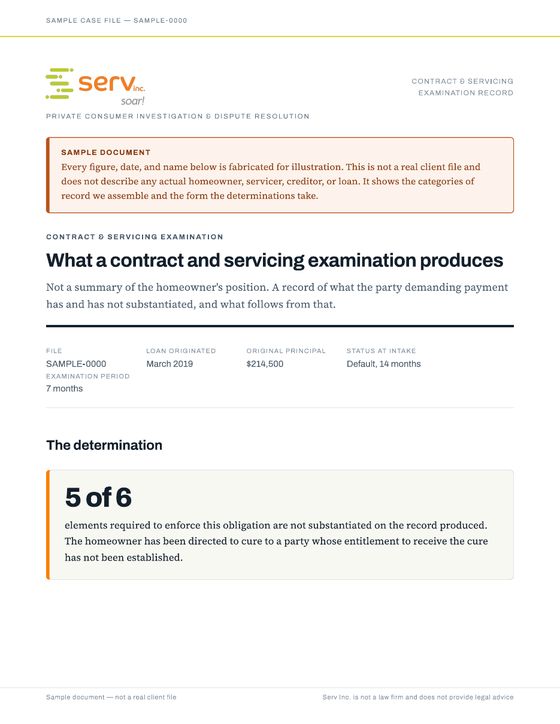
Get the full slide deckA complete sample examination record, with every figure made up for illustration. It includes a section on why the findings matter to a counseling agency, and what to confirm before applying any client assistance funds.
Open the sample reportA referral means trusting us with a homeowner’s most sensitive financial records. We treat that responsibility with care, and the principles below govern how we handle it.
We examine records at the level of a single account, for the benefit of the person that account belongs to. A client’s information is never turned toward the servicer, the lender, or a sale.
We work from the file the homeowner provides, one account at a time, and in detail.
We begin only after the homeowner gives informed, written consent. They decide what to share, and they can withdraw at any time.
Every finding serves that homeowner’s own case. We do not use a client’s information against them or for anyone else’s benefit.
We do not sell client data, and we do not share it with the servicer, lender, or broker. We hold no financial relationship with any of them.
When the same problem shows up across accounts, such as a servicer that repeatedly misapplies payments or a fee that keeps reappearing, we study it in de-identified form. That work helps us recognize the issue faster in the next homeowner’s file, and no individual is identified in the process.
Records are stored securely and are seen only by the people working the file. When a matter closes, the client’s information is handled according to our records policy and is not repurposed.
The counselor provides the homeowner with our client-choice disclosure and, with consent, emails a short case summary to icd@servincorporated.com. The step takes only a few minutes.
We review the file under RESPA, TILA, FDCPA, FCRA, and Regulation E and identify the servicer violations that can be acted on, each documented with the record behind it.
We issue the formal challenges, such as Qualified Written Requests and Notices of Error, and report milestones back to the referring counselor, so that outcomes can be recorded on the HUD 9902.
Non-exclusive. We expect to be listed alongside other community options, such as Legal Aid and your state attorney general’s consumer division. You preserve full client choice under 24 CFR 214.303.
No financial exchange. No referral fees, commissions, or anything of value pass in either direction (24 CFR 214.303(f)). Members pay Serv directly. Your agency never pays and is never paid.
Disclosable as a non-industry resource. The relationship can be disclosed to clients consistent with 24 CFR 214.303(g), and no additional conflict disclosure is required for a non-industry community resource.
Some directors ask why a service in this space charges at all, and it is a fair question to raise. The honest answer is that almost no one funds the homeowner’s side of a servicing dispute. Public funding in housing counseling supports counseling and loss mitigation. That work is essential, but it stops short of independently examining and challenging a servicer’s record. The professionals who can read servicing records against RESPA and the related rules are, for the most part, employed by the lenders and servicers. When a homeowner needs someone to question the account itself, the market offers very little.
A homeowner can hire a private attorney, and some do. Attorneys who handle this work, when they agree to take a single servicing dispute, charge far more than most families in default can pay, and many decline these matters because the economics do not work for a one-off case. A homeowner who simply wants their record examined is left with few affordable options.
Serv is paid directly by the homeowner, as a flat membership rather than a contingency, and the fee is a fraction of an attorney engagement. Nothing we earn depends on the outcome or on the source of the referral. Being paid by the member, and by no one else, is what keeps us independent. We accept nothing from lenders, servicers, or your agency, so our only obligation runs to the homeowner. The initial review is free, so a homeowner can learn whether anything is worth pursuing before paying. You can see the full pricing on our pricing page.
This matters because a homeowner who questions their account is often told by the servicer that the record is correct, sometimes after only a limited review, and written requests for information can go unanswered. Without an independent examination, the homeowner has no way to test that answer. Providing that examination at a price a homeowner can actually meet is the reason we exist, and the reason we charge.
Cost should not be the reason a homeowner in distress goes without an examination of the record. When a homeowner faces a budget shortfall, we arrange a payment plan and begin on the budget they have. When a homeowner cannot afford anything at all, and your program is willing to subsidize the cost, we will work directly with the agency to set that up. Our aim is to keep this help within reach of the people who need it most.
HUD asks your agency to keep working relationships with community resources for needs beyond your scope (24 CFR 214.103(j), and the community-resource provisions of HUD Handbook 7610.1). An independent, non-industry resource like Serv is a straightforward way to round out that base on the consumer-protection side, and RESPA compliance is itself a listed performance criterion. A homeowner with an unresolved servicing dispute is the kind of need the provision is meant to cover.
What partnering does for your agency:
Whether you add us is entirely your decision, and you remain free to refer a client wherever you judge best.
When a homeowner’s situation calls for regulatory intervention, and our review identifies improper foreclosure practices, we report aggregate data about servicer conduct to the appropriate regulators. We do this only with the homeowner’s written agreement. The record concerns the conduct of servicers. Your agency is not the subject of it, and nothing about your agency is graded, scored, or reported.
Review the agreement and workflow before you decide. Your counsel is welcome to review the MOU, and it is terminable by either party at any time.
Memorandum of Understanding: the zero-cost, non-financial referral agreement (PDF) Referral Intake Checklist: the one-page counselor workflow (PDF) Partnership Determination Form: record your decision (PDF) Sample Case Report: what a contract and servicing examination produces, with illustrative figures (PDF) White Paper: Reading the Lien After the Loan Is Sold
Tell us who you are and we’ll send the MOU and onboarding details, or sign it right here.