White Paper
The Institutional Compliance Gap
Civic incorporation, systemic extraction, and the case for a parallel Bureau of Record.
A foreclosure is carried out by a chain of five roles. A servicing employee computes the figure, a default services vendor orders the documents, a foreclosure firm files and publishes, a substitute trustee conducts the sale and a notary acknowledges the instruments. Each role answers to a different body under a different qualification standard, and no single regulator has authority over the foreclosure the five of them produce together.
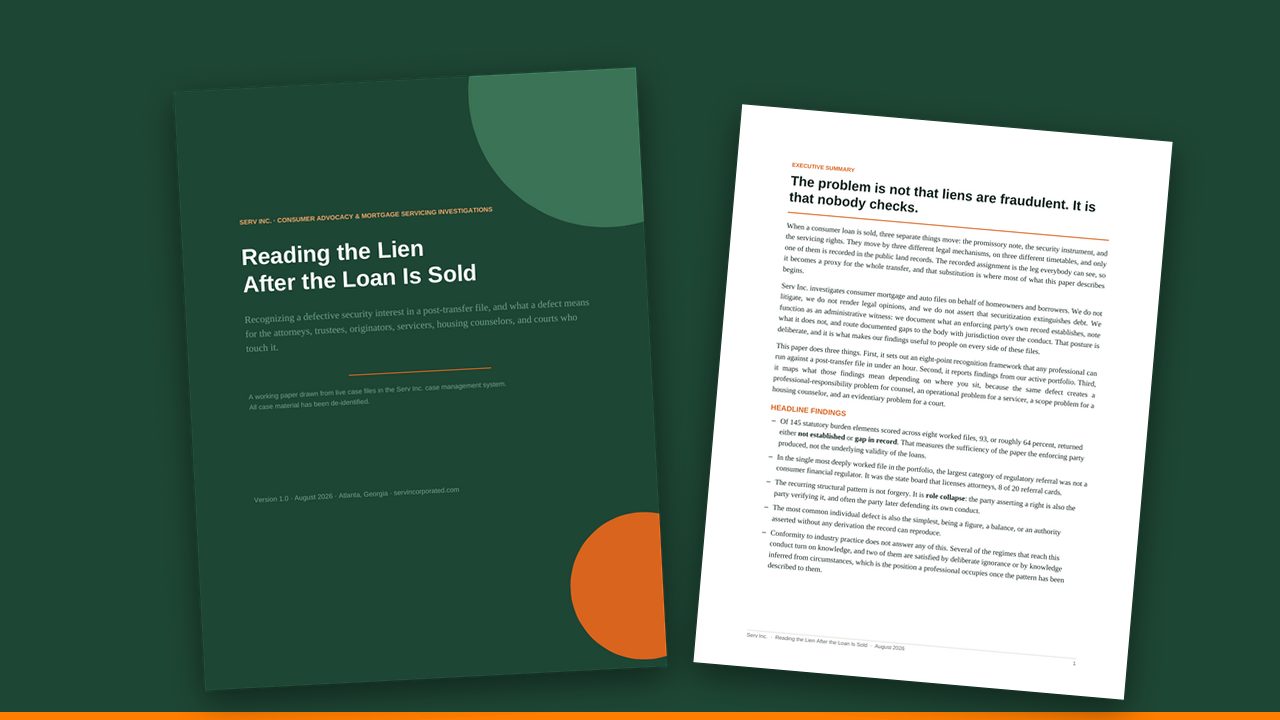
Across eight worked files in the Serv Inc. portfolio, 93 of 145 scored burden elements, about 64 percent, were not carried by the enforcing party’s own record. That figure describes the sufficiency of the paper the enforcing party produced and says nothing about whether the underlying loans are valid.
| Role | What its training does not reach |
|---|---|
| Servicing staff | Everything, including the figure that starts a foreclosure |
| Originators | Servicing, transfer, assignment and default administration |
| Substitute trustees | The independence the statute assumes |
| Attorneys | Regulation X |
| Notaries | Acknowledgment practice at industrial volume |
| Housing counselors | Nothing relevant. Counselors are the most tested role in the chain and the one with the least authority to act on what they find. |
If the cause were individual carelessness, errors would be scattered at random across files. The portfolio shows the same defect, the same template and the same unanswered request handled the same way by different institutions. Uniform failures at that scale come from a shared procedure, which makes this a training and supervision problem that can be predicted, tested for and taught.
The 19-slide deck sets out the three structural causes, explains what licensing boards can and cannot reach, identifies the professional conduct rules that already apply, and closes with six requirements a workable competence standard would contain: verify before certifying, derive every figure before stating it, know the response windows, map each document to the element it proves, read the instrument, and have somewhere to send a file that fails on its face.
If your organization trains or supervises people who work in this chain, see how we work with partners.
Tell us where to send follow-up research, and the download starts right away.
We use your email to send this and related Serv Inc. research. See our privacy policy.
Civic incorporation, systemic extraction, and the case for a parallel Bureau of Record.
A working paper for attorneys, trustees, originators, servicers, housing counselors and courts: an eight-point framework for recognizing a defective security interest in a post-transfer file, with...
A Georgia foreclosure sale has to be preceded by a written notice mailed at least 30 days ahead. Here is what the law requires that letter...
About two emails a month, with our latest research on mortgages, foreclosure and pooled debt. Unsubscribe with one click.
Upload your documents and we will send a free summary of what the record establishes, what is missing and why it matters.