Auto Loans

Your car loan was sold. Find out what the record shows.

Most car loans are signed at a dealership, assigned to a finance company, and often pooled with thousands of others and sold to investors. Each handoff leaves records, and the company collecting from you has rules to follow on payments, fees and repossession. We request those records and check them.

The Records

What you have probably never been shown.

These records decide what you owe and who can collect it. They are rarely sent to you, and almost never explained. We request them, examine them and tell you in plain language what they prove and what they do not.

  • The assignment showing who holds your contract now
  • The full payment history, including how each payment was applied
  • The fees charged to your account and the contract terms that allow them
  • After a repossession: the sale notice, the sale price and the calculation of what is still owed
What We Check

The rules your file is measured against.

01

Who holds the contract

We trace the contract from the dealer to whoever claims it now. Under the federal Holder Rule, a company that takes your contract generally takes it subject to the claims and defenses you had against the seller.

16 CFR Part 433
02

How payments were applied

We reconcile the lender's payment history against your own records and the contract's terms for interest, late fees and add-on products.

Your contract · State law
03

Electronic payment errors

If a payment left your account and went missing, or was never authorized, your bank has to investigate when you report it in time. We put the report in writing and track the deadlines.

12 CFR 1005.11 (Regulation E)
04

Repossession and sale notices

Before a repossessed car is sold, the lender generally has to send you notice. After the sale, it has to be able to explain how it calculated what you still owe or are owed.

UCC Article 9 (state versions vary)
05

Credit reporting

We compare what the lender reports about the account with what its own records show, and document the differences for a dispute.

Fair Credit Reporting Act
After the Record Goes Out

What a corrected record can lead to.

We do not promise results, and every file depends on what its records show. When a dispute is documented and pursued properly, these are outcomes it can produce:

  • Payments credited or refunded when money was misapplied or never owed.
  • Fees removed when the contract does not allow them.
  • A deficiency balance reduced or withdrawn when the sale notices or the calculation do not hold up.
  • Credit reporting corrected when it does not match the account records.
  • A record that holds up. Then you know the obligation is sound, in writing, and can plan around it.
See the Work

See the form your findings take.

Sample report · PDF · 12 pages

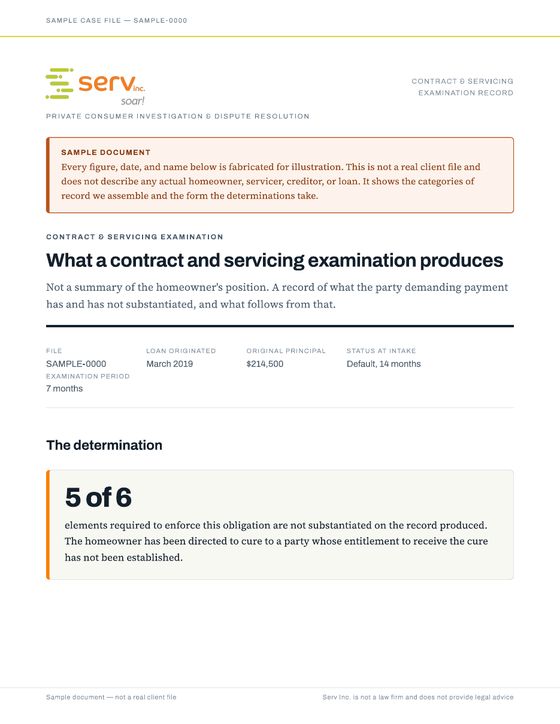
What an examination produces

This sample is a mortgage file, with every figure made up for illustration. An auto loan examination follows the same method: each thing the other side has to establish, what its own record shows, and a plain determination on every line.

Open the sample report
Common Questions

What people ask.

Can my car loan be sold without my permission?

Yes. Most contracts allow the lender to assign the loan, and many car loans are sold or pooled for investors. A sale does not change the terms you agreed to. The new company has to be able to show it holds your contract, and you keep the claims and defenses the contract and the law give you.

What can I ask for after a repossession?

You can ask for the notice of the planned sale, the date and price of the sale, the fees charged, and a written explanation of how any remaining balance was calculated. State law sets the details and the deadlines, so the answer depends on where you live.

The lender says it cannot find my payment. What now?

Put the dispute in writing to both the lender and your bank, with proof the money left your account. Your bank has duties to investigate electronic payment errors that are reported in time. We document the dispute and track the response deadlines.

Do you negotiate with my lender?

No. We examine the record, explain what it proves and what it does not, and with your authorization send notices, track deadlines and route findings to the regulators responsible. What you do with the record is your decision.

Want to know what your own records show?

Upload your documents and we will send a free summary of what the record establishes, what is missing and why it matters.

Upload your documents, free