Debt Collectors and Debt Buyers

A collector says you owe it money. We check whether the record supports that.

Old credit card, medical and loan debts are sold in bulk, often more than once, and the paperwork does not always travel with them. Federal law gives you the right to ask a collector to verify the debt. We examine what comes back and show you what it proves.

The Records

What you have probably never been shown.

These records decide what you owe and who can collect it. They are rarely sent to you, and almost never explained. We request them, examine them and tell you in plain language what they prove and what they do not.

  • The bill of sale or assignment for each time the debt changed hands
  • The original creditor's account records
  • An itemization showing how the balance grew
  • The collector's license or registration in your state
What We Check

The rules your file is measured against.

01

Verification of the debt

A collector must send you a notice with specific information about the debt. If you dispute it in writing within 30 days, the collector has to stop collecting until it sends verification.

15 USC 1692g · 12 CFR 1006.34
02

Who owns the debt

We trace the debt from the original creditor through each sale and document any gap in the chain.

Bills of sale · Account records
03

The amount

Interest, fees and charges added after default have to be authorized by the original agreement or by law. We itemize the balance and flag what the record does not support.

15 USC 1692f
04

The dates

Every state limits how long a debt can be sued on. A collector may not sue, or threaten to sue, on a debt past that limit. We document the dates that decide it.

12 CFR 1006.26
05

Credit reporting

A collector generally has to communicate with you about a debt before it reports the debt to a credit bureau.

12 CFR 1006.30
06

Licensing

Many states require collectors to be licensed or registered. We check the collector's status where you live.

State law
After the Record Goes Out

What a corrected record can lead to.

We do not promise results, and every file depends on what its records show. When a dispute is documented and pursued properly, these are outcomes it can produce:

  • Collection stopped when the collector cannot verify the debt.
  • The balance corrected when added interest or fees are not supported.
  • Credit reporting corrected or removed when it does not match the record.
  • A file ready for your attorney if the collector has sued.
  • A record that holds up. Then you know the debt is valid, in writing, and can decide how to handle it.
See the Work

See the form your findings take.

Sample report · PDF · 12 pages

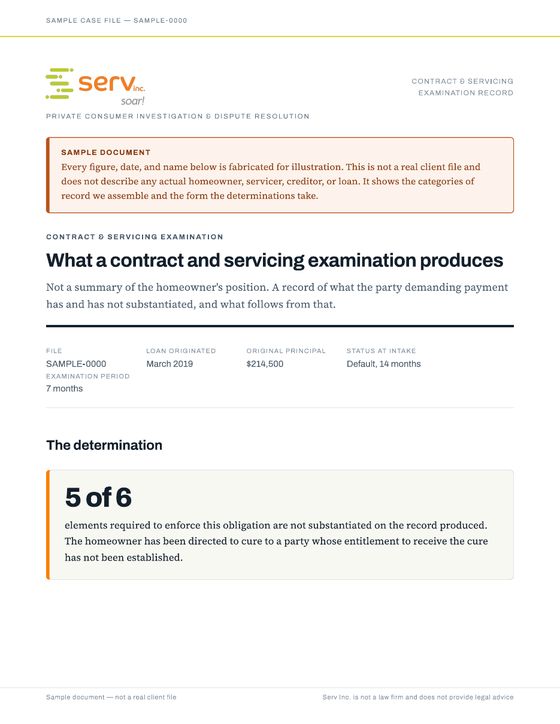
What an examination produces

This sample is a mortgage file, with every figure made up for illustration. We examine a collection account the same way: each thing the collector has to establish, what its own record shows, and a plain determination on every line.

Open the sample report
Common Questions

What people ask.

What is a debt validation letter?

It is a written request, sent within 30 days of the collector's first notice, asking the collector to verify the debt. Once it arrives, the collector has to pause collection until it mails you verification. Send it by a method that proves delivery and keep a copy.

Can a debt be sold more than once?

Yes. Debts are often sold in large batches and resold. Each sale should be documented, and a collector that sues should be able to show the chain from the original creditor to itself.

Should I pay an old debt to make it go away?

That is your decision, and it can have legal consequences. In some states a payment on an old debt can restart the time limit for a lawsuit. We show you the dates and documents in the record so you can decide with the facts in front of you, and an attorney can advise you on your state's rules.

I was sued by a collector. Can you help?

A lawsuit has court deadlines, and missing one can mean a judgment against you. We can examine the collector's documents and prepare the record for you or your attorney. We do not represent you in court.

Want to know what your own records show?

Upload your documents and we will send a free summary of what the record establishes, what is missing and why it matters.

Upload your documents, free