Practice Area · Mortgage

Mortgage sold, transferred or in foreclosure? We investigate the record.

Federal law sets rules for how your servicer handles payments, escrow, written requests and foreclosure. We check your file against those rules and your own loan documents, and give you a record showing where they were followed and where they were not.

Housing Counseling
Working with a housing counselor? Keep going.

A HUD-approved counselor helps you with your budget, your options and your applications. We do a different job. We examine how your loan has been serviced and document what we find. Many homeowners use both, and your counselor can add our record to your file.

Has anyone checked your servicer's side of the file? Written requests, escrow and dual tracking are where we start.
See what we check →

How we help prevent foreclosure.

Federal servicing rules limit when a servicer can foreclose, and they require it to investigate errors you report in writing. Most homeowners never use those rules because no one told them they exist. We find the errors in your file, put them in writing under those rules, and track every deadline the servicer has to meet.

Short Video

Who checks the payoff figure?

Video · 1 min 35 sec

Who does the trustee work for?

A foreclosure sale is run by a substitute trustee who is expected to be neutral. This short video follows the money from the high bid to the surplus, names the three documents that decide the number, and gives four ways to get the math in writing.

Six federal areas servicers get wrong.

Mortgage servicing errors are common, and most are never examined. These are the six bodies of federal law we check your file against.

R

RESPA Servicing Violations

Failure to respond to Qualified Written Requests, improper escrow handling, force-placed insurance abuse, and notice of error violations.

12 USC § 2605 · 12 CFR § 1024
F

FDCPA Debt Collection

Mortgage servicers acting as debt collectors are bound by the FDCPA. Misrepresentation, harassment, and false statements about amounts owed are common violations.

15 USC § 1692 · 12 CFR § 1006
D

Dual Tracking & Loss Mitigation

Servicers pursuing foreclosure while a loss mitigation application is pending violates federal regulations. So does improper denial without required notices.

12 CFR § 1024.41 · Reg X
C

Chain of Title Defects

Defective assignments, MERS irregularities, missing endorsements, and securitization breaks. These defects exist whether you're in default or not.

UCC Article 3 · State recording statutes
Q

QWR & Notice of Error

RESPA requires written acknowledgment within 5 business days and substantive response within 30. Servicer failures here create direct statutory liability.

12 CFR § 1024.36 · § 1024.35
F

Force-Placed Insurance

Improper imposition of lender-placed insurance, failure to follow required notice procedures, and inflated premiums billed back to the escrow account.

12 CFR § 1024.37 · RESPA

What Your Servicing File
Can Tell You.

A working series on the federal servicing rules most homeowners never hear about, and how to use them.

CC
Published by The Corporate Critic
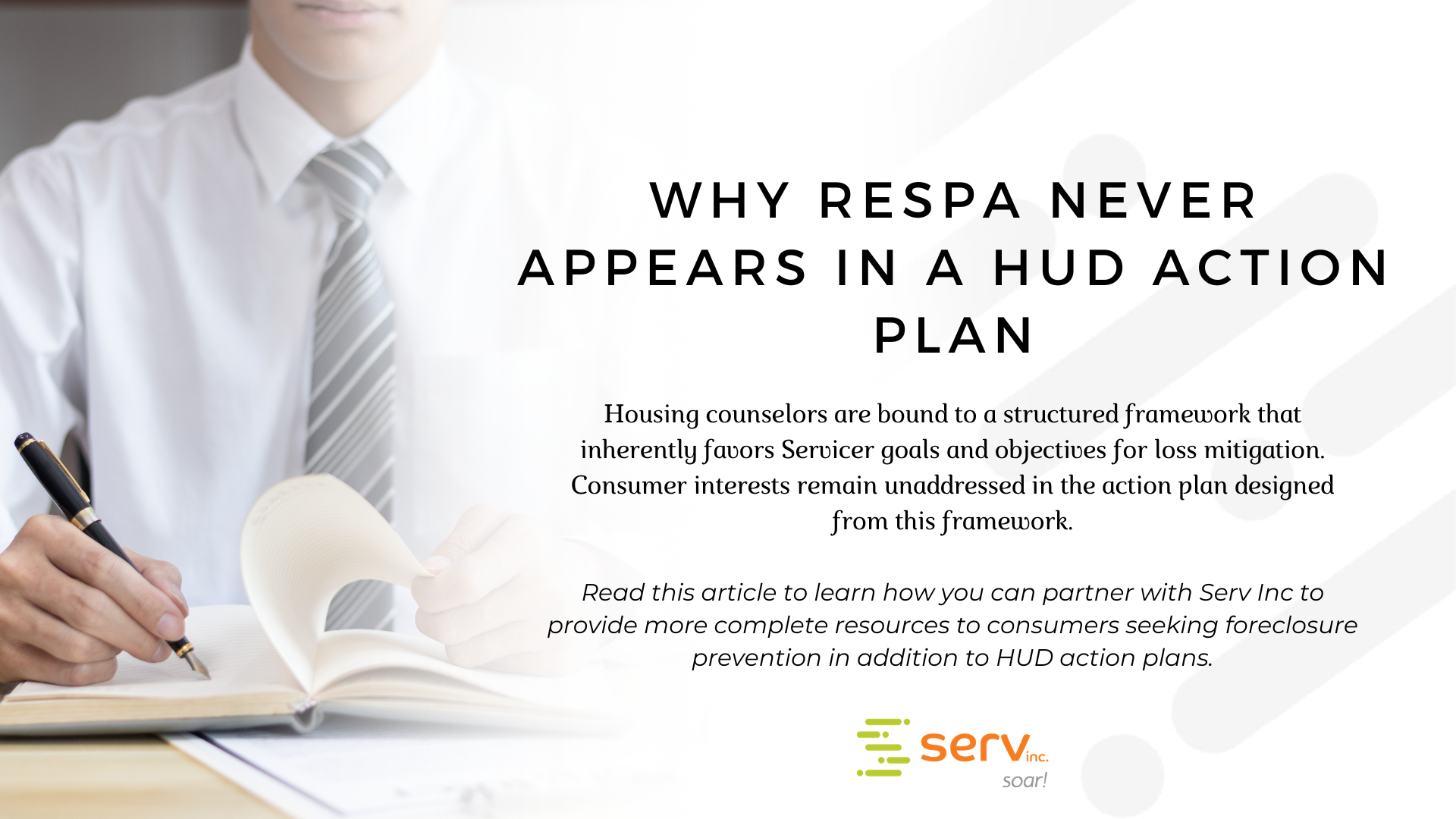
Why RESPA Never Appears in a HUD Action Plan
Part 01 Featured

Why RESPA Never Appears in a HUD Action Plan.

HUD-approved housing counselors are working from a template defined by HUD Handbook 7610.1. That template is built for budgeting, loss mitigation applications, and program eligibility - not for surfacing federal servicer violations. RESPA, the most powerful tool a homeowner has against a non-compliant servicer, doesn't appear in the action plan because the action plan was never designed to identify it. Here's the regulatory architecture that produces this gap, and what gets missed because of it.

Read the full piece →
Part 02

The Dual Fiduciary Duty Problem.

24 CFR § 214.303 requires HUD counselors to "act in the homeowner's interest" - while also maintaining working relationships with the servicers and lenders that fund and feed the counseling pipeline. We examine what happens when those duties conflict.

Read part 02 →
Part 03

The Closed-Loop Referral Network.

Counselors refer to the same servicer programs, attorneys, and HUD-aligned nonprofits over and over. The referral network is not adversarial to servicers - by structural design. Here's the architecture, and what it means for a homeowner asking for outside review.

Read part 03 →
Part 04

How Counselor Compensation Bends the Outcome.

Counseling agencies are measured on completions: applications filed, plans submitted, files closed. They are not measured on whether the homeowner kept the house, or whether the servicer violated federal law. Metrics drive behavior. Here's how.

Read part 04 →
Part 05

QWRs and the 30-Day Trigger.

The Qualified Written Request is one of the most powerful - and least used - tools a homeowner has. We break down how it works, what to send, what the servicer must respond, and what their failure creates.

Publishing soon · subscribe to The Corporate Critic
Part 06

Dual Tracking After the 37-Day Rule.

Federal regulations restrict servicers from pursuing foreclosure while a loss mitigation application is under review. The rule has teeth - and is violated routinely. Here's how to spot it in your own file.

Publishing soon · subscribe to The Corporate Critic
Part 07

Chain of Title in the Securitization Era.

Most modern mortgages have been sold, packaged, securitized, and re-assigned multiple times. The paper trail is supposed to be clean. Often it isn't. Here's what to look for, and what defects mean for the homeowner.

Publishing soon · subscribe to The Corporate Critic
The Violations We Document · Independent · Sourced · On the Record

Four servicer behaviors that create liability.

These are the violation categories most frequently produced by mortgage servicer files we review. Each is sourced to a specific federal authority. Each is documentable from the records your servicer is required to produce.

01

The Unanswered QWR

You send a Qualified Written Request demanding the servicing history. The servicer is required to acknowledge within 5 business days and substantively respond within 30. Many don't - or respond with non-responsive boilerplate. Each failure creates statutory liability.

12 USC § 2605(e) · 12 CFR § 1024.36
02

The Dual-Tracked Foreclosure

You submit a complete loss mitigation application more than 37 days before a scheduled foreclosure sale. The servicer is generally barred from moving for foreclosure judgment or sale until the application is evaluated. Many proceed anyway.

12 CFR § 1024.41(g) · Reg X
03

The Defective Assignment

An assignment of mortgage executed by someone without authority, recorded after the foreclosure was filed, or breaking the securitization chain. The recorded paper doesn't match the actual transactional history.

UCC Article 3 · State recording law
04

The Force-Placed Insurance Scheme

The servicer claims your homeowners insurance lapsed, force-places a policy with a related entity at 3-5x market premium, and bills your escrow. Federal regulations require specific notices and verification procedures that are routinely skipped.

12 CFR § 1024.37 · RESPA

Patterns we've documented.

Composite examples drawn from active member files. Details modified to protect member identity; legal architecture preserved.

RESPA · QWR Failure

Servicer ignored 4 successive QWRs over 18 months.

Homeowner sent QWRs requesting payment history and escrow analysis. Servicer sent generic acknowledgment letters with no substantive response. Pattern documented across 18 months of correspondence. Each failure created independent statutory liability.

What we built
A documented RESPA violation record with sourced authority for each instance.
Reg X · Dual Tracking

Foreclosure motion filed during loss mitigation review.

Complete loss mitigation application submitted 52 days before scheduled sale. Servicer's foreclosure counsel moved for judgment 14 days later. Application was still under review. Regulatory bar was clear.

What we built
A 12 CFR § 1024.41(g) violation record with full timeline documentation.
Chain of Title

Assignment executed by a vice president of a company that didn't exist.

Recorded assignment of mortgage signed by an officer of the originating lender. The originating lender had been dissolved 3 years prior. The signature was a known robo-signer. The recorded chain of title was facially defective.

What we built
A chain of title defect record sourced to public recordings and corporate dissolution filings.

Housing counseling and record investigation.

They do different jobs, and many homeowners use both.

HUD Housing Counseling

Helping you with your options.

HUD-approved agencies working under 24 CFR Part 214
  • Intake and budgeting built around your household finances.
  • Program eligibility and loss mitigation applications.
  • Action plans for the steps you can take with your servicer.
  • Referrals to HUD-approved programs and resources.
  • Free to the homeowner.
Serv Inc. Investigation

Examining how the loan was serviced.

Independent record investigation and dispute resolution support
  • File analysis against RESPA, FDCPA, Regulation X and state law.
  • Independent, with no servicer relationship.
  • Records built to support written demands, regulator complaints or litigation.
  • Attorney referral when litigation is the right step.
  • Works alongside your counselor, who can add the record to your file.
  • Membership model, paid by the homeowner.
Read the Work

See what an examination looks like on paper.

The sample report shows the record a member receives. The white paper sets out the method behind it for attorneys, housing counselors and other professionals.

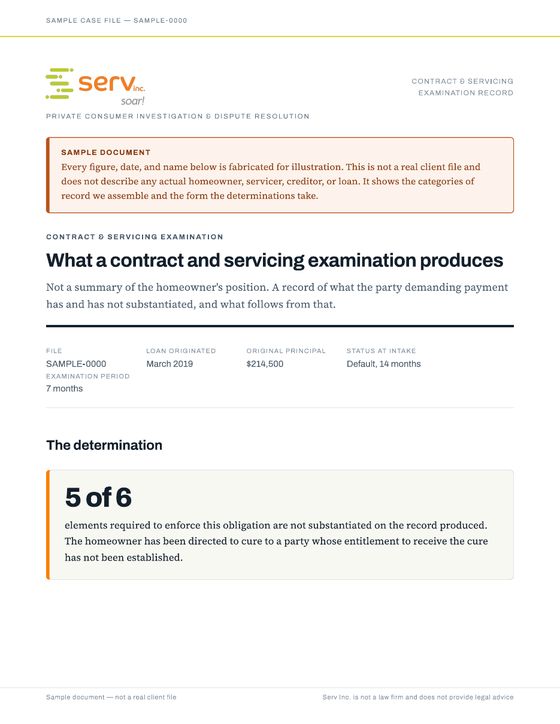
Sample report · PDF · 12 pages

What an examination produces

A complete sample examination record, with every figure made up for illustration. It shows the determination on each element the other side has to establish, the charge-by-charge audit, the response deadlines, and what a homeowner can do with the result.

Open the sample report
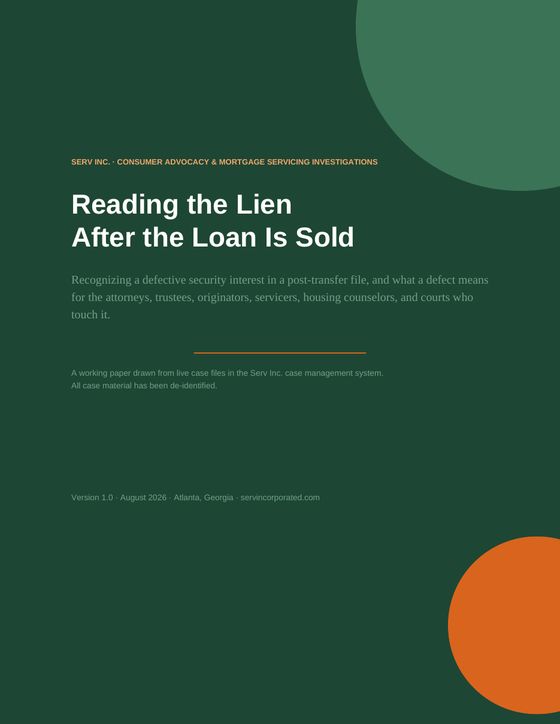
White paper · 36 pages

Reading the Lien After the Loan Is Sold

An eight-point framework for recognizing a defective security interest in a post-transfer file, with findings from 145 scored burden elements. Written for attorneys, trustees, originators, servicers, housing counselors and courts.

Get the white paper

What people ask about mortgage cases.

Should I use a HUD housing counselor or Serv Inc.? +
Many homeowners use both. A HUD-approved housing counselor helps with your budget, your options and your loss mitigation applications, at no cost to you. Serv Inc. does a different job: we examine how your loan has been serviced, check the file against RESPA, Regulation X and your own loan documents, and document what we find. Your counselor can add our record to your file.
Why hasn't anyone mentioned RESPA to me? +
Housing counseling action plans focus on budgeting, loss mitigation applications and program eligibility. Checking a servicer's conduct against RESPA (the Real Estate Settlement Procedures Act) is separate work. RESPA governs how servicers handle fees, written requests, force-placed insurance, escrow and dual tracking. That review is what Serv Inc. does.
What is a Qualified Written Request (QWR)? +
A Qualified Written Request is a formal written demand sent to a mortgage servicer under RESPA, requiring the servicer to acknowledge receipt within 5 business days and respond substantively within 30 business days. QWRs can demand the full servicing history, payment application records, escrow analyses, transfer documents, and explanations of charges. Servicer failure to respond properly creates statutory liability and is one of the most common federal violations in mortgage servicing.
What is dual tracking and is it illegal? +
Dual tracking is when a mortgage servicer continues to pursue foreclosure while simultaneously reviewing a homeowner's loss mitigation application. Federal regulations under 12 CFR § 1024.41 restrict dual tracking - once a complete loss mitigation application is received more than 37 days before a foreclosure sale, the servicer generally cannot move for foreclosure judgment or sale until the application is evaluated and the homeowner has had time to respond. Dual tracking violations are one of the most actionable forms of servicer misconduct.
Can chain of title defects be discovered if my mortgage payments are current? +
Yes - and it's the best time to investigate them. Chain of title defects, defective assignments, MERS irregularities, and securitization problems exist independent of payment status. Members who discover defects while in good standing have far more strategic options than those who discover them under foreclosure pressure. A proactive analysis is the lowest-cost, highest-leverage way to know what's actually in your file.
Do I need to be in foreclosure to use Serv Inc.? +
No. We serve homeowners at every stage: current and proactive, recently past due, in active loss mitigation, in pre-foreclosure, and in foreclosure. Earlier engagement generally produces better outcomes because there's more time to build the record before any sale deadline. Members in active foreclosure should engage immediately given time pressure.

Upload your mortgage file.
Get a free summary analysis.

If there's a federal violation in your file, you'll know within the week - and you'll know exactly what to do next. No subscription required to find out.